
Aug 24, 2026Operating
Coverage Goes to Zero
Buying and selling is about to be commoditized, the way stock trading was in 1975. Here is what does not get cheap.
From 1792 until 1975, a stock trade on the New York Stock Exchange cost one to two percent. The rate was fixed. Every broker charged the same. A hundred shares was about $49.
You were not paying for the trade. A trade is a line in a ledger. You were paying because the floor was the only place it could happen, and you were not allowed to stand on it.
Then the SEC killed fixed commissions. Over the next few decades the rate fell something like 95 percent. Eighty cents a share down to four cents. In October 2019, Schwab went to zero. Everyone else followed inside a week.
What broke was not the price. It was the bundle.
Firms had sold execution, research, and advice as one thing at one rate. Once execution was free they had to put a number on each piece. Some of those pieces were worth paying for. A lot of them were not. More than 160 firms merged or disappeared. The shops that sold access died. The shops that sold judgment put a new price on it. Wealth management ended up bigger than brokerage ever was.
The fee did not go away. It left the trade and showed up in the relationship.
Same thing is about to happen to how you buy a building, a company, a software contract, a freight lane, a government bid.
Whoever runs that process takes a cut. The cut pays for two different jobs. Coverage: who do I even call. Judgment: which of those calls is real. They get sold as one product because they have always shown up in the same person. That is the same reason NYSE commissions stayed bundled for 180 years.
Coverage is the piece going to four cents.

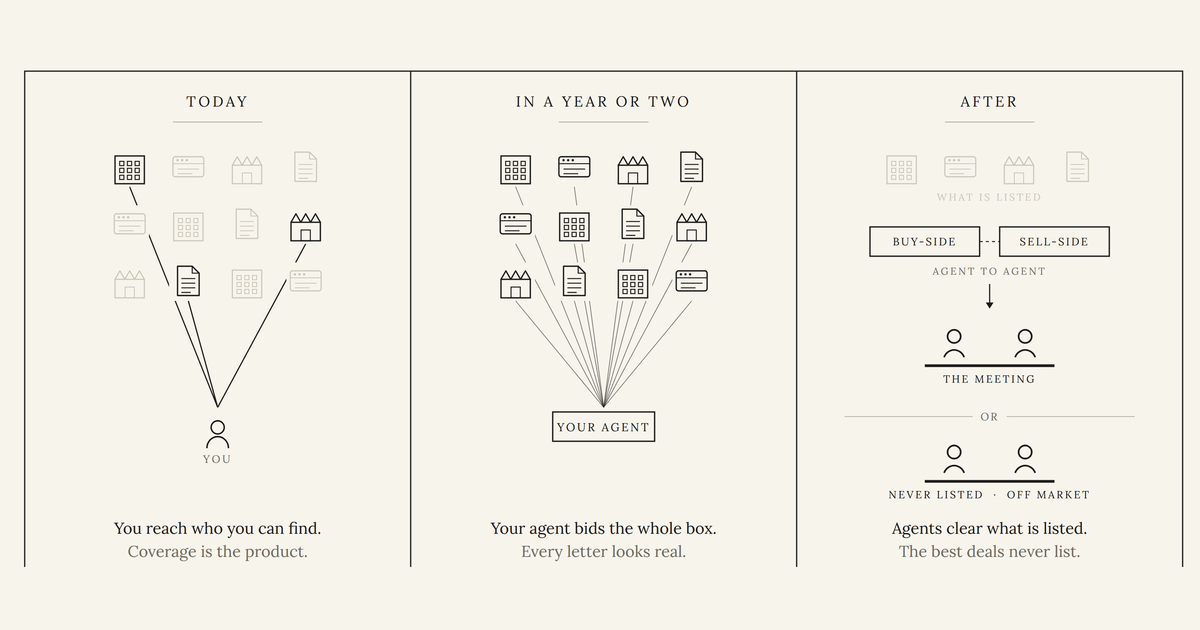
Today
You search. You call people you know. You run a process.
You reach the sellers you can find. That is a small slice of the sellers who exist. That limit is the product. It is why the broker gets paid. It is also why an off-market deal still feels like someone did you a favor.

In a year or two
Your AI agent already has the box. Price, size, geography, whatever you typed in. It does not pick ten names and approach three. It sends an LOI to every asset that fits.
The seller is not choosing among three serious groups. The seller is reading a hundred letters that all look real.
An LOI used to mean something because it was expensive and slow. It is still just a non-binding document. An analyst burned a weekend. A partner put a name on it. Sending a hundred of them would have cost the firm its reputation. The cost was the signal. Take the cost out and the letter is an email.
So the sell side stops sourcing and starts triaging. Sellers will charge for attention. Proof of funds before the dataroom. A deposit to get to the next round. A spam filter, rebuilt for deals.
After
Humans leave the middle. Buy-side AI agents talk to sell-side AI agents. They trade the facts. They get the approvals. You do not meet anyone until both sides are done.
The meeting that is left is not a process meeting. The numbers are finished. You are in the room because someone still has to decide if they want to do this with you. Sell you the house. Sell you the company. Award you the contract. By then that is the only decision left.
Four ways to win
If coverage is free, the edge has to live elsewhere. Better AI agents will help for a minute. Then everyone has the same tool, and you are competing on whatever did not get cheap. I can think of four places it goes.
Certainty of close: You actually close. At the price you said. You do not re-trade. When every letter looks real, that is the only line in the pile anyone can check.
The ugly deals: Agents will be good at the clean middle of a market and bad at the edges. Hair on the deal. A lawsuit. Environmental. A family fight in the cap table. A seller who needs a structure, not a number. The machine bids what it can model. The money moves to what it cannot.
Better data: You know something about the asset that nobody’s agent can scrape. Real, and getting rarer, because scraping is the thing improving fastest.
Better relationships: The house never lists. The company never lists. It never hits the internet. Someone calls you before there is a process, because there was never going to be one.
Only the last one compounds, and it goes somewhere I do not love. Cheap coverage does not open the market. It floods whatever is listed until listed is where the leftovers sit. The good stuff gets pushed into a smaller room, with people who already know each other.
Free access to every asset is worth less than it sounds. The ones worth having were never posted.
Subscribe nowAlex Kirshenbaum is an investor and co-founder at The 81 Collection, a high-growth equity fund that invests minority positions in service and manufacturing businesses at the intersection of cash flow and technology. Please reach out to alex@81collection.com for further inquiries.