
Jan 29, 2026Fundraising
The White Space of Funding
Why the best businesses often don’t fit venture capital or private equity
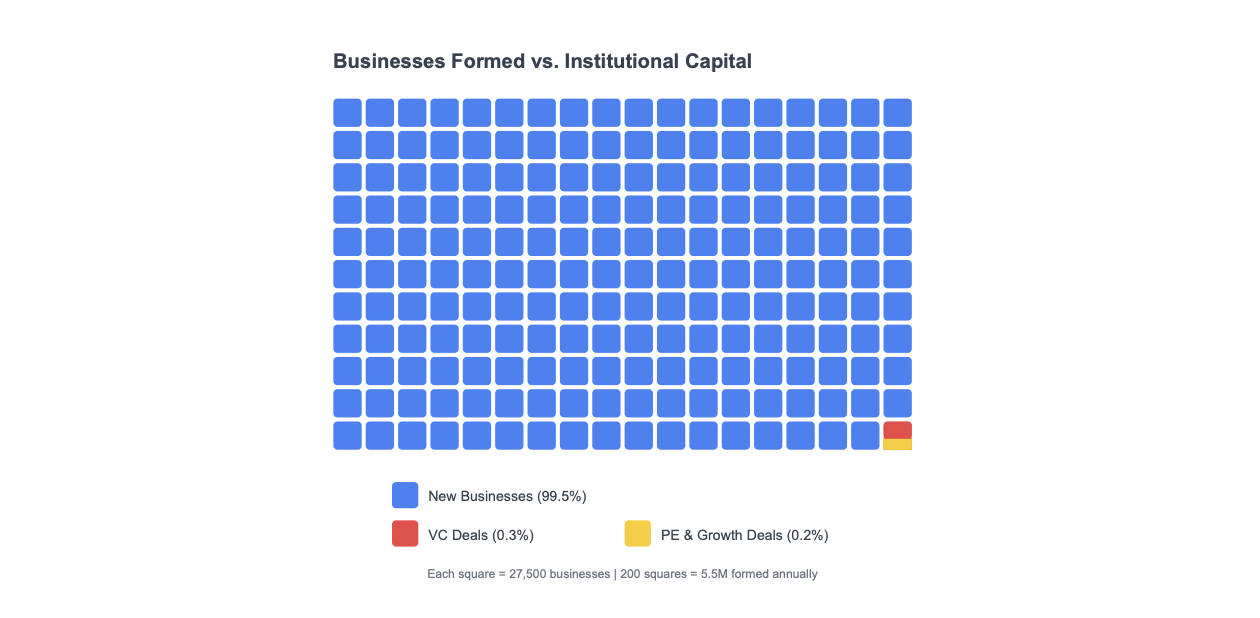
Every year in the U.S. 5–6 million new businesses are formed, and roughly 1.4 million actually open their doors. For many of them, hiring employees and expanding into new markets is extremely difficult without access to outside capital.
Now compare that to the world of institutional capital:
Even in a very strong economic year, that’s about 25,000–30,000 total deals.
Simple math: roughly 98% of businesses will never raise VC, growth equity, or private equity—and many don’t need to. See below for an idea of the scale of businesses that get institutional funding:

How Institutional Capital Typically Works
While every firm is different, most institutional investors broadly fit into the following buckets:

The Problem: A Massive Funding Gap
Now imagine this business: A services company with a real labor force
This is a good business. A very good one.
But here’s what usually happens:
This is the gap we built 81 Collection for.
Most institutional capital is structured around extremes. Venture capital is optimized for companies that can grow explosively and support massive outcomes. Private equity is built for businesses with stable cash flow and enough scale to deploy large checks. But the vast majority of great businesses sit in the middle. They are real operating companies with strong fundamentals, improving margins, and clear paths to durable growth, yet they do not fit neatly into either bucket.
To give you an example, we recently invested in a tech-enabled ambulatory infusion center (Uptiv Health).
This is not a pure software company that can raise unlimited capital to chase growth at all costs. But it is also not a mature cash-flow business that private equity can simply lever. It is a mission-critical healthcare services company with real operations, recurring demand, and a clear opportunity to use technology to improve efficiency and unit economics.
That is exactly the kind of business the traditional funding market often misses.
Not every great outcome requires massive dilution, five fundraising rounds, or an IPO. If a founder raises $5–10M of equity, layers in thoughtful debt, and scales a durable, capital-efficient business, they can reach a ~$250M exit with significantly higher ownership and a much more realistic path to success than chasing a $10B+ outcome.
These businesses can compound through recurring revenue, operational leverage, and cash-flow-funded growth, requiring fewer future outside raises. That is the structurally underwritten model we focus on at 81.
At 81, we believe value is created by combining:
We back founders building durable businesses in overlooked sectors like services and manufacturing, with the goal of scaling efficiently, preserving founder ownership, and achieving strong outcomes without following the traditional venture or buyout path.
To learn more visit The 81 Collection