
May 14, 2026Finance
Three Ways to Value the Same Business
Why VC and PE both mis-price the kinds of companies I like best, and what we do instead at 81
Take a small home services business. Plumbing, HVAC, pest control. Pick your vertical. It’s doing $250K of EBITDA, growing at a reasonable clip, and the founder just hired a CTO with a real track record to build the platform layer.
The founder goes out to raise a few million dollars. Two doors open.
Door one: PE
The PE firm sees a home services business. Businesses of this scale generally trade around 3 to 6x EBITDA, and home services are no exception. At $250K of EBITDA, that puts the business between $750K and $1.5M of enterprise value.
At those numbers, the PE door isn’t really a door. No serious PE firm is writing a meaningful check at a $1M valuation, and even if one would, the founder would be giving up most of the company for less capital than they need to build anything.
Hard pass.
Door two: VC
The VC sees the CTO hire and the platform roadmap and prices the business off the future they imagine: strong gross margins, sticky retention, dominant share in a fragmented market. The number that comes back: $30M post-money valuation.
The math: $5M raised, founder retains 45%. By any normal measure of a Series A, this looks like a great outcome. Capital to build, meaningful ownership, a valuation that validates the vision.
The founder takes door two.
The risk nobody priced in
The business just sold equity at 120x EBITDA. That number isn’t a reflection of the present, it’s a promise about the future. The founder has implicitly committed to growing into a valuation that justifies an even higher one at the next round.
If the platform takes longer to land, or the market softens, or adoption slips even a few quarters, the next round prices the business closer to where it actually is. Today roughly one in seven priced rounds close below the prior valuation.

What happens next
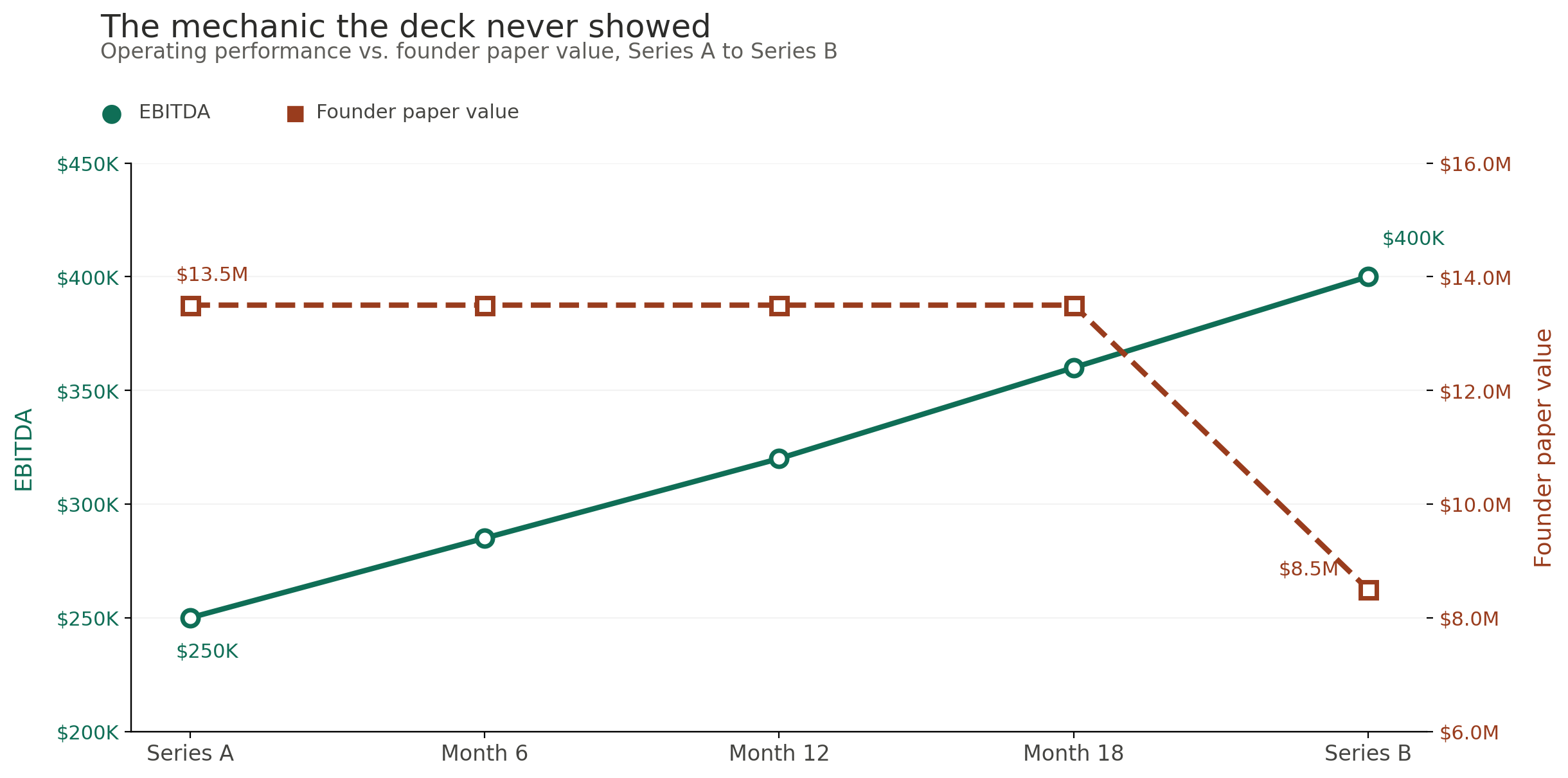
The platform got built. Adoption took longer than the deck assumed. EBITDA grew from $250K to $400K. Real progress, just not the trajectory underwritten at Series A.
Founder decides to raise again and the Series B comes back at $20M pre, $25M post-money valuation. A down round. And the math compounds negatively for the founder:
At Series A: 45% of $30M = $13.5M on paper. At Series B: 34% of $25M = $8.5M on paper.

Real execution. Real growth. Real product built. And the founder is $5M poorer on paper than the day they signed the Series A term sheet 24 months earlier.
What we do at 81
We refuse to pick a single number.
Performance is the biggest driver of what the business is worth. Every investment underwrites it. Almost no investors treat it that way. They guess at it, lock it into a valuation at entry, and the founder lives or dies by the gap between the guess and the outcome.
81 makes performance an input to the cap table, not just an output from it.
We price the business above PE comps but below the VC narrative number. Then we structure the upside around what it might become.
If the founder hits home-run outcomes, they unlock additional equity. That equity comes out of our stake, not theirs. We get diluted because they’re winning, which is exactly when investors should be willing to give something back.
If the business performs like a PE deal, the founder’s ownership stays where it started. Our preferred stock protects the downside. The Founder’s common stock is preserved. Nobody gets hurt.
A dynamic cap table for a non-binary world.
A third door
The instinct is to pick a side. Anchor on PE math and lose the deal. Anchor on VC math and set the founder up for a brutal down round if execution comes in anywhere short of perfect.
The better answer is to refuse the choice. Price the business for what it is today. Structure the upside for what it might become. Let the cap table catch up to reality as reality unfolds.
That’s the bet we’re making at 81. So far, it’s the bet the founders we back are making with us.
Subscribe nowAlex Kirshenbaum is an investor and co-founder at The 81 Collection, a high-growth equity fund that invests minority positions in businesses at the intersection of cash flow and technology. Please reach out to alex@81collection.com for further inquiries.