
May 29, 2026Finance
What Uber Taught Me About Gross vs. Net
Six months in the driver's seat in 2017, and the lesson I still use to evaluate marketplaces today
In 2017, between breaks at school and during my senior year at Illinois, I drove for Uber. Champaign mostly, some Chicago when I was home.
I started for the same reason most people do. Flexible hours, no boss, dollars stacking up on the screen.
Six months in, I had a different view.
Gross was the story. Net was the truth.
The app printed your gross earnings everywhere. Big bold number on every screen.
Gross is the headline number, what you brought in before any costs. Net is what’s actually left after you pay for everything it took to earn it.
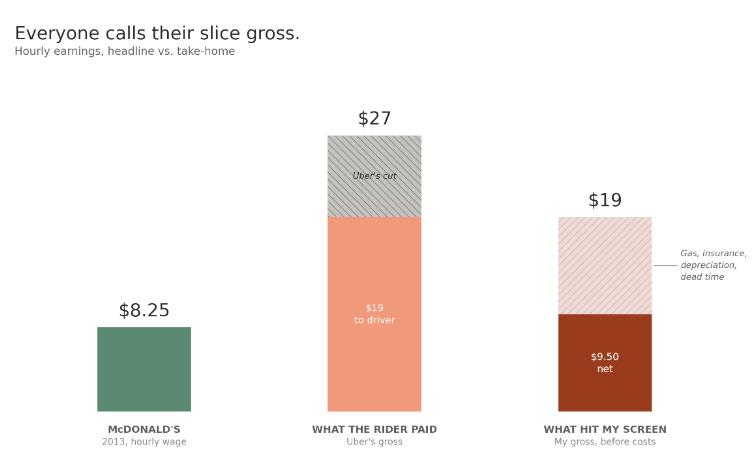
Except the “gross” the app showed me wasn’t really gross. The rider was paying $25 or $30 for a 25 minute trip. Uber took its cut first. What hit my screen as $19 was already net of Uber’s slice. They just called it gross because, to me, it was.
Then I had my own slice to take out. Gas. Insurance. Depreciation on my Honda. Dead time between rides. When I did the math, I was clearing about $9.50 an hour.
For context: I’d worked at McDonald’s three years earlier at $8.25 an hour. That was wage equals take-home. McDonald’s didn’t ask me to depreciate anything.

So my “platform of the future” gig was paying me about a dollar more than drive-thru duty in high school. Once you saw the net number, you couldn’t unsee it.
The ding
Except the app made it really hard to keep seeing it.
The thing I think about most isn’t the math. It’s the sound the app made when a ride came in.
A specific ding. Once you’ve heard it a few hundred times, your body responds before your brain does. You’re in a parking lot, you’ve decided you’re done, and the ding hits and you take the ride. Every time.
The surge animations. The little nudges (“you’re $4 away from your goal”). The “you’re in demand” notification right when you tried to log off.
I wasn’t deciding when to work. The app was. And the gross number was the bait that kept the loop running.
The Champaign warehouse riders
It was easy to forget I wasn’t the only one in this loop. The riders were too.
Outside Champaign, there are big distribution warehouses. Many of the people working those shifts didn’t own cars, so they Ubered to work. Some every day.
A round trip from town could run $25-30, more on surge. On a shift paying $15 an hour, that’s 2 hours of work gone before you clocked in.
I drove one woman three or four times across a few months. She was saving for a car so she could stop paying for Ubers to get to the job she needed to pay for the Ubers.
She was running the same arithmetic I was. Her gross paycheck looked one way. Her net (after the Ubers, after the time, after everything the job actually cost her to show up to) looked very different.
The platform was sitting in the middle, advertising the gross to both of us.
What it changed about how I invest
A few years later I started evaluating marketplaces professionally. The pattern from the Honda showed up on day one.
Every marketplace pitches gross. GMV, gross bookings, gross transaction volume. Big bold numbers on every slide.
But every layer in the stack calls its own slice gross. The rider’s “fare” is the platform’s “gross.” The platform’s “gross” becomes the driver’s “gross.” The driver’s “gross” still has gas, insurance, and depreciation to take out before there’s anything actually left.
The number that matters is net revenue after pass-through, after take rate, after the rebates and incentives the platform pays to keep supply and demand from leaving. It’s usually buried two appendices deep, if it’s there at all.
And take rate compression is real. Competition forces the platform to give more back. Supply gets sophisticated and demands a higher cut. Demand gets price-sensitive and resists fees. The gross can grow forever while the net flatlines or shrinks.
When I evaluate a marketplace today, I want to see net first. If the founder leads with gross, I assume the net story isn’t strong enough to lead with.
Same instinct I built in 2017. Different scale.
The lesson
Gross is what gets printed on the screen. Net is what’s actually yours.
A great business clears a real net. A great platform pays a real net to the people working on top of it. A great founder knows the difference and isn’t afraid to show you.
I learned it in a Honda in central Illinois, one ping at a time. It still holds up.
Alex Kirshenbaum is an investor and co-founder at The 81 Collection, a high-growth equity fund that invests minority positions in businesses at the intersection of cash flow and technology. Please reach out to alex@81collection.com for further inquiries.